
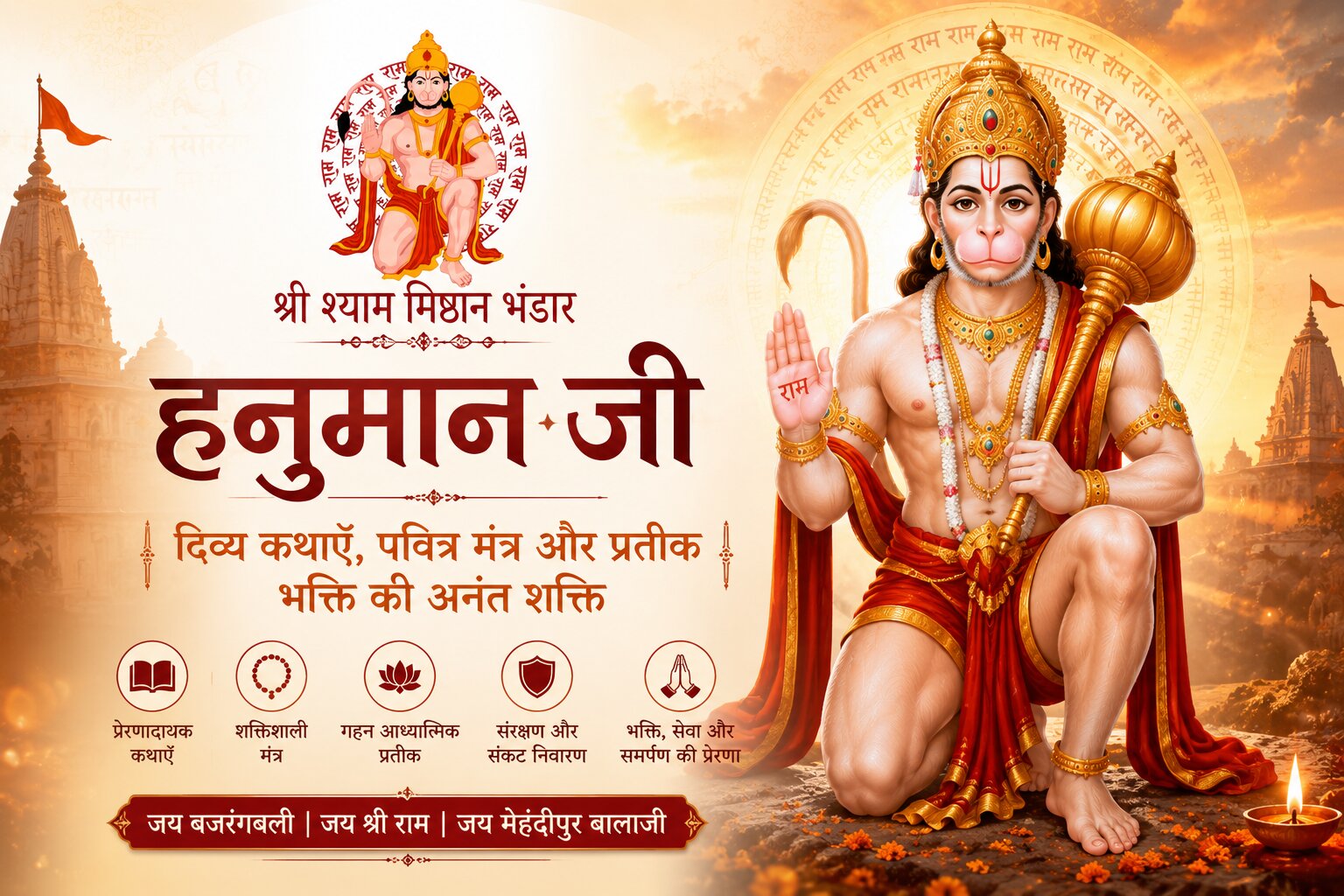
Lord Hanuman Ji is one of the most beloved and revered deities in Hindu tradition. He is worshipped as a symbol of strength, courage, wisdom, humility, devotion and selfless service. His life and stories remind devotees that true strength is not simply physical power—it is the ability to remain devoted, disciplined and humble even when one possesses extraordinary abilities.
From his miraculous childhood adventures to his unwavering service to Lord Shri Ram, Hanuman Ji's journey is filled with inspiring lessons. His devotion is so profound that he is often remembered as the perfect example of Bhakti, while his control over the mind and senses reflects the ideals of spiritual discipline and yoga.
At Mehandipur Balaji Mandir, Hanuman Ji is especially revered as Balaji Maharaj, and devotees come with faith and devotion to seek His blessings and spiritual protection.
In this article, let us explore some fascinating stories of Hanuman Ji, the significance behind his divine forms, his connection with Lord Ram, and the spiritual lessons his life offers.
Hanuman Ji's birth is associated with Anjana and Kesari, with Vayu Dev playing an important role in his divine origin. From childhood, Hanuman Ji displayed extraordinary energy, courage and spiritual power.
One of the most famous stories from his childhood tells how young Hanuman Ji looked at the glowing Sun and believed it to be a delicious, ripe fruit. Filled with innocent curiosity, he leaped toward the sky to catch it.
His incredible leap amazed the celestial beings. During this episode, Indra Dev used his Vajra, causing Hanuman Ji to fall to the earth and injuring his jaw. Vayu Dev, distressed by what had happened to his son, withdrew the air from the universe.
The gods soon understood the seriousness of the situation. To pacify Vayu Dev and bless Hanuman Ji, various divine beings granted him extraordinary blessings and protection.
These divine boons became a foundation for the immense strength and fearlessness for which Hanuman Ji would later become famous.
According to traditional accounts, Hanuman Ji received blessings from several deities. These blessings included protection from weapons, freedom from the effects of fire, extraordinary strength and longevity.
Yet one of the most meaningful aspects of his story is that Hanuman Ji did not become arrogant because of these powers.
His strength remained connected to devotion.
He used his abilities in the service of others and, above all, in the service of Lord Shri Ram.
This teaches an important spiritual lesson: great power becomes truly meaningful when it is guided by humility and devotion.
Hanuman Ji was not only powerful; he was also deeply committed to knowledge.
He chose Surya Dev as his Guru and requested to be taught despite the Sun God's constant movement across the sky.
Hanuman Ji offered a remarkable solution: he would travel before Surya Dev's chariot and learn while the Sun journeyed across the heavens.
Impressed by his determination, Surya Dev accepted him as a student.
Through his dedication, Hanuman Ji became highly learned and was associated with knowledge of the Vedas, philosophy, spiritual disciplines and various branches of learning.
The story highlights another important quality of Hanuman Ji:
Devotion and strength are incomplete without knowledge and discipline.
One of the most important moments in Hanuman Ji's life came when he met Lord Shri Ram and Lakshman during their search for Mata Sita.
Hanuman Ji recognized the greatness of Shri Ram and devoted himself completely to His service.
From that point onward, his life became an extraordinary example of Seva and Bhakti.
Whether searching for Mata Sita, crossing the ocean, carrying the Sanjeevani mountain or helping Shri Ram's army, Hanuman Ji performed every task with courage and complete dedication.
He never sought personal fame or reward.
His only desire was to serve his beloved Lord.
During the search for Mata Sita, Shri Ram's vanara army reached the ocean separating them from Lanka. The challenge seemed almost impossible.
Hanuman Ji himself initially appeared uncertain about his ability to make the enormous leap.
Then Jambavan reminded him of the divine strength that already existed within him.
As Hanuman Ji remembered his true power, his confidence awakened.
He expanded his form and leaped across the ocean toward Lanka.
This story carries a powerful message for everyone:
Sometimes our greatest abilities remain hidden until faith, encouragement and determination awaken them.
Hanuman Ji therefore represents not only physical strength but also the unlimited potential within the human mind.
After reaching Lanka, Hanuman Ji searched carefully for Mata Sita and eventually found her in Ashoka Vatika.
He gave her Shri Ram's message and reassured her that Shri Ram would come to rescue her.
Before leaving Lanka, Hanuman Ji demonstrated his extraordinary strength and courage. His actions created fear among Ravana's forces and ultimately became an important turning point in the events leading toward the great battle.
Yet even in the midst of these heroic deeds, Hanuman Ji remained focused on his mission.
His strength was always directed toward Dharma and Seva.
Hanuman Ji is often regarded as an ideal example of discipline, concentration and control over the senses.
His life reflects the qualities associated with Yoga—discipline of the body, control of the mind and dedication to a higher purpose.
Traditional stories also associate Hanuman Ji with the knowledge of breath and Pranayama through his connection with Vayu Dev.
His calmness, focus and extraordinary ability to concentrate provide inspiration for devotees and spiritual practitioners.
Hanuman Ji teaches us that controlling the mind can be more powerful than controlling the world around us.
Hanuman Ji is widely revered as a powerful protector and remover of fear.
Devotees traditionally turn toward Hanuman Ji when facing fear, difficulties, negative influences or spiritual concerns.
His fearless character represents the victory of courage over fear and Dharma over destructive forces.
This is one reason Hanuman Ji holds such an important place in devotional traditions across India.
At Mehandipur Balaji, devotees have deep faith in Balaji Maharaj and seek His divine grace, protection and blessings.
A popular traditional story describes an encounter between Hanuman Ji and Shani Dev.
According to the story, Shani Dev approached Hanuman Ji while he was engaged in serving Lord Shri Ram. Hanuman Ji requested that Shani Dev wait until his service was complete.
When Shani Dev insisted, Hanuman Ji allowed him to sit upon his head.
Hanuman Ji then continued carrying heavy rocks and performing his work. As the weight became unbearable, Shani Dev eventually requested that he be released.
The story is traditionally remembered as an illustration of the protective power associated with sincere devotion to Hanuman Ji.
For this reason, many devotees worship Hanuman Ji on Saturdays and recite Hanuman-related prayers with faith.
One popular devotional story connects Hanuman Ji's vermilion-colored form with Mata Sita.
Hanuman Ji noticed Mata Sita applying Sindoor and asked about its significance. She explained that it was associated with the well-being and long life of Lord Shri Ram.
Because Hanuman Ji's devotion to Shri Ram was absolute, he thought that if a small amount of Sindoor could express love and devotion, then he should cover his entire body with it.
The story beautifully reflects the depth of his devotion.
It is also associated in popular tradition with the Sindoor-covered appearance of Hanuman Ji seen at many temples.
Perhaps one of the most powerful images of Hanuman Ji is the depiction of him opening his chest and revealing Shri Ram and Mata Sita within his heart.
The story expresses the deepest meaning of Bhakti.
For Hanuman Ji, Shri Ram was not merely someone he worshipped from a distance. Shri Ram lived within his heart and consciousness.
The image therefore symbolizes:
Hanuman Ji's message is simple yet profound:
When devotion becomes complete, the Divine becomes the center of one's heart.
Panchmukhi Hanuman Ji is a significant and fascinating form of Hanuman Ji.
The five faces are traditionally associated with Hanuman, Narasimha, Garuda, Varaha and Hayagriva.
Each form carries its own symbolic meaning and is associated with different divine qualities such as courage, protection, wisdom, strength and victory over negative forces.
Panchmukhi Hanuman Ji is therefore revered as a powerful representation of divine protection and spiritual strength.
Beyond the fascinating stories and miraculous feats, Hanuman Ji represents a profound spiritual ideal.
He combines:
Strength with humility.
Knowledge with devotion.
Courage with discipline.
Power with selflessness.
In spiritual interpretations of the Ramayana, Shri Ram represents the Divine, while Mata Sita represents the individual soul. Hanuman Ji's devotion becomes the force that helps bring the individual closer to the Divine.
In this sense, Hanuman Ji represents Bhakti—the path of loving devotion that overcomes ego and brings the devotee closer to God.
The life of Hanuman Ji offers lessons that remain meaningful even today.
Hanuman Ji's leap across the ocean reminds us that we may possess abilities we have not yet recognized.
Despite extraordinary powers, Hanuman Ji remained humble and devoted.
His greatest joy was serving Lord Shri Ram rather than seeking recognition.
Hanuman Ji was both a mighty warrior and a learned devotee.
His fearless nature inspires devotees to face difficulties with courage and spiritual confidence.
Mehandipur Balaji is one of the most revered pilgrimage destinations associated with Hanuman Ji.
Devotees visit Shri Mehandipur Balaji Maharaj with deep faith and devotion. The temple holds a special place in the spiritual traditions surrounding Hanuman Ji, and countless devotees consider Balaji Maharaj a source of strength, protection and divine grace.
The devotion surrounding Mehandipur Balaji reflects the enduring faith that people place in Hanuman Ji as a protector and compassionate divine presence.
For devotees, visiting Balaji is not simply a journey to a temple—it can also become a deeply personal spiritual experience filled with prayer, faith and surrender.
The stories of Hanuman Ji are much more than tales of supernatural strength and heroic adventures. They reveal the qualities of a perfect devotee—faith, courage, humility, wisdom, discipline and selfless service.
Hanuman Ji's greatest power was not simply his ability to cross oceans or defeat powerful forces. His greatest strength was his unwavering devotion to Lord Shri Ram.
That devotion continues to inspire millions of people.
Whether remembered as Pawan Putra, Bajrangbali, Mahaveer or Balaji Maharaj, Hanuman Ji remains a timeless symbol of courage and Bhakti.
May the blessings of Shri Mehandipur Balaji Maharaj bring strength to the heart, courage to the mind and faith to every devotee.
Jai Shri Ram. Jai Bajrangbali. Jai Mehandipur Balaji Maharaj!
Hanuman Ji is traditionally described as the son of Anjana and Kesari, with Vayu Dev playing a divine role in his birth and upbringing.
Hanuman Ji performed extraordinary feats throughout the Ramayana, including crossing the ocean to Lanka and carrying the Sanjeevani mountain. His physical strength, however, was always guided by devotion and humility.
Hanuman Ji dedicated his life completely to Shri Ram. He performed every task with selfless devotion and never sought personal glory for his achievements.
A popular devotional story connects Hanuman Ji's vermilion form with his deep love for Shri Ram and Mata Sita. It symbolizes devotion, auspiciousness and complete surrender.
Panchmukhi Hanuman Ji is a five-faced form traditionally associated with Hanuman, Narasimha, Garuda, Varaha and Hayagriva. The form represents various aspects of divine strength, protection and wisdom.
Saturday worship of Hanuman Ji is particularly popular in Hindu tradition, partly because of traditional stories concerning Hanuman Ji and Shani Dev. Devotees pray to Hanuman Ji seeking courage, protection and relief from difficulties.
Mehandipur Balaji is a renowned temple dedicated to Balaji Maharaj, a revered form of Hanuman Ji. Devotees visit the temple with faith and prayers seeking divine blessings and protection.
.png)